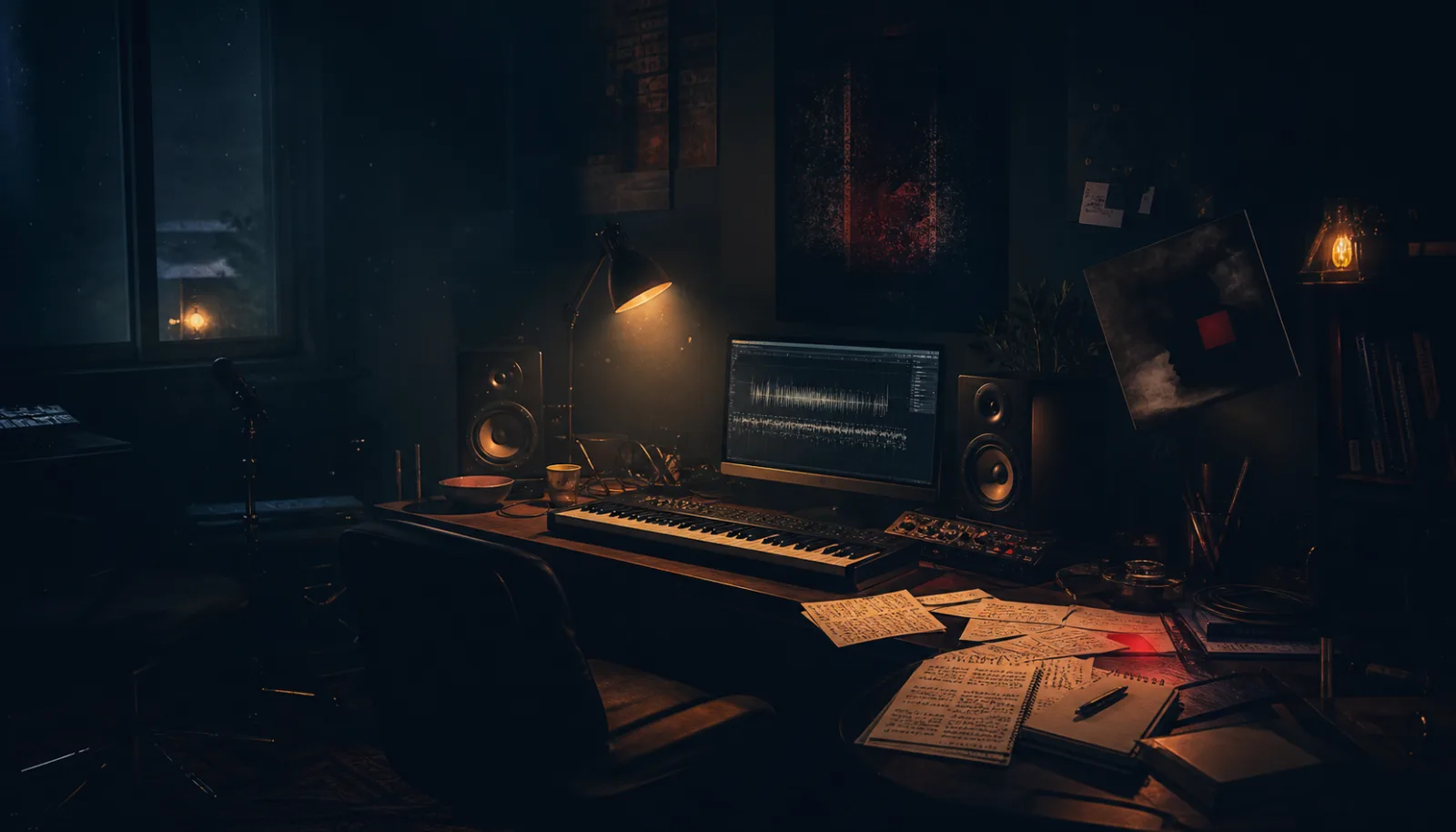
Every track, before becoming a finished release, passes through a less orderly place. It is not a song yet, not a production yet. It is a collection of intuitions, attempts, repeated listens, and useful mistakes. For an independent musician, that space is often the real studio: a mental room where the sound is searched for before it is fully recorded.
The First Idea
Sometimes everything begins with a chord, a melodic line hummed quietly, or a rhythm discovered almost by accident. Other times it starts from listening: a texture, a distant drum pattern, a bass sound that leaves space around it. It is not about copying. It is about understanding what emotional temperature is calling.
At this stage, I try not to judge too quickly. I open a project, save a draft, try different sounds, change the tempo, move a note. The danger is wanting to decide immediately what the track should become. Often, the piece needs to stay open for a while. It needs to breathe before it can take a final shape.
From Sound Search to Arrangement
Searching for the right sound is not a technical detail separated from writing. A pad can change the meaning of a melody. A kick that is too strong can make a passage feel rigid when it was asking for lightness. Even silence, when respected, becomes part of the arrangement.
When I build a track, I try to ask what role each element has. Is the drum part supporting the idea, or is it invading it? Is the bass creating movement, or only filling space? If there is a voice, should it stand in front, or should it move through the mix like a shadow? These are practical questions, not abstract ones. They help remove what does not serve the music.
In an independent studio, the tools may be limited, but that is not always a negative limitation. Sometimes a reduced setup forces more precise choices. One synthesizer, a few samples, a session in FL Studio or another familiar environment can be enough if the idea is clear and the listening is honest.
Doubt as Part of the Process
Doubt follows almost every stage of the work. A section can feel strong at night and weak the next morning. It happens. The ear changes, the mood changes, and the distance from the song changes too. That is why I often let a draft rest before deciding whether to keep it, cut it, or rewrite it.
Refinement is the point where honesty matters. Not everything that has been recorded deserves to remain. Some ideas were only useful because they helped move the track forward. Removing them does not mean losing work. It means creating space for the right direction.
Sometimes refinement is about a harsh frequency, a volume that is slightly too high, or a reverb that pushes the scene too far away. Other times it is about having the courage not to add anything. The temptation to fill the space is strong, especially when working alone. But a track does not improve because it contains more things. It improves when every element has a reason.
Releasing While Staying Independent
Then comes the moment when the track has to leave the room. Releasing music is not only uploading a file to a platform. It means accepting that something born in a private phase begins to live outside the creator’s total control. Someone may listen distractedly. Someone else may enter it deeply.
For an independent artist, releasing music brings both valuable freedom and practical responsibility. You choose sounds, timing, images, descriptions, distribution, and rights management. You can move from a listening platform to a YouTube video, from a distribution form to a registration process with Soundreef, without fully separating the creative side from the organizational one.
Independence, however, should not become isolation. Even when working alone, you are still listening to the world: records, noises, conversations, cities, silence. Every track carries some of these presences inside it. The difference is learning how to turn them into something personal, without chasing a shape that has already been approved by someone else.