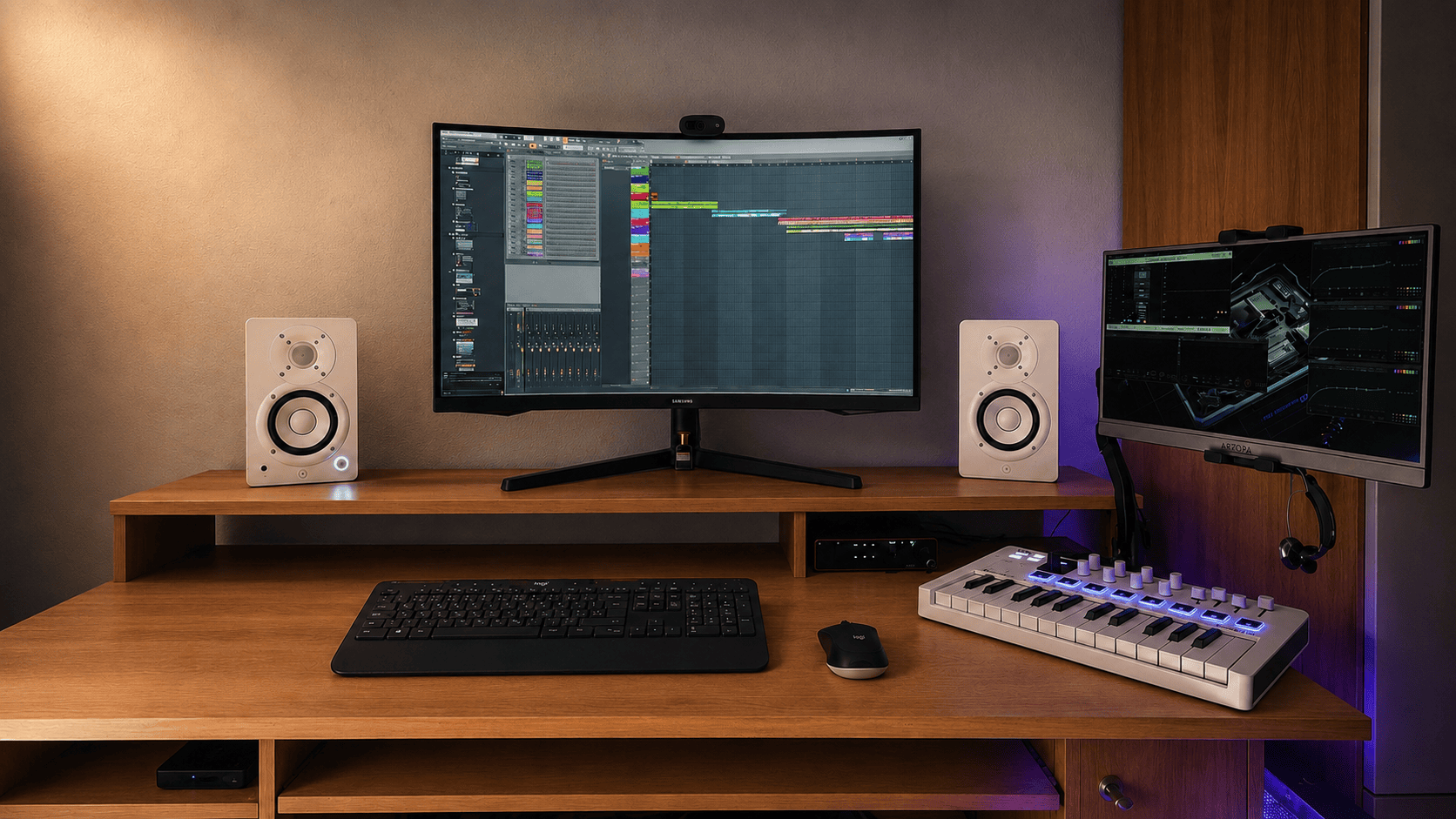
Journal · Sound & Process
EQ and the Space Between Sounds
When I work with EQ, I do not begin by asking how to make every sound bigger or more beautiful. I ask where that sound should live.
In a production, every element asks for space. A voice, a bass, a piano, a pad or a small detail in the background can all be beautiful on their own. But music does not happen one sound at a time. It happens in the relationship between them.
Sometimes balance means bringing something forward. More often, it means allowing something else to step back.
Looking Helps. Listening Decides.
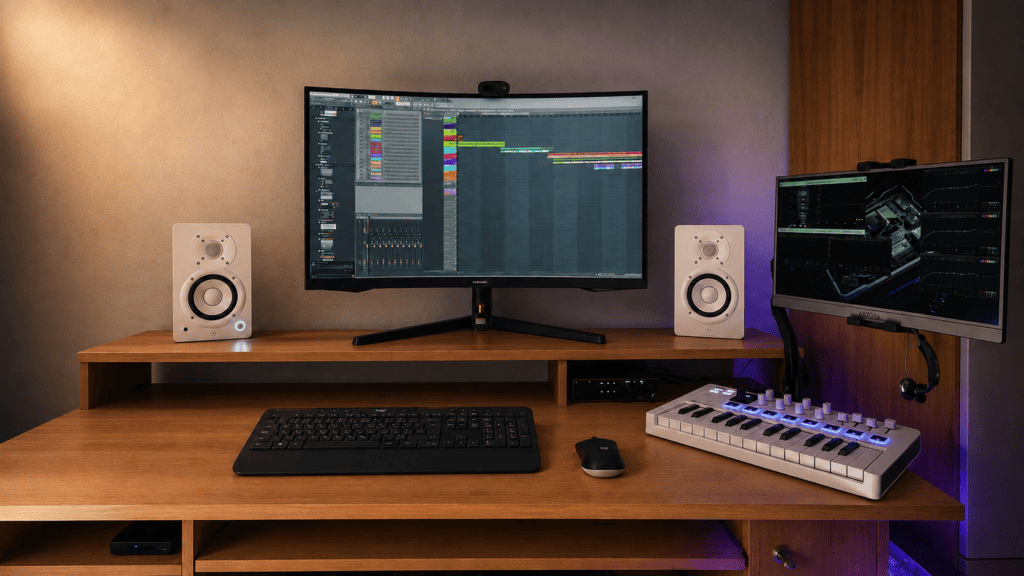
I can spend a long time looking at curves on the second screen, moving a frequency by a few decibels and listening again. The visual information helps me understand what may be happening, but it cannot make the final decision.
A perfect-looking spectrum can still feel cold, crowded or without direction. At some point, I have to stop watching and listen.
The two speakers in front of me do not tell me whether the mix is technically impressive. They tell me whether the music can breathe. Whether the voice still feels close. Whether the bass supports the song without occupying the entire room. Whether a small sound can remain fragile without disappearing.
Subtraction Can Create Presence
EQ, for me, is not only correction. It is a conversation between sounds.
A frequency is removed, and suddenly the vocal feels more present. A low-mid area becomes quieter, and the whole arrangement opens. Nothing new has been added, but the emotion becomes clearer.
This is the part of production that interests me most: understanding that subtraction can create presence.
Leaving the Song Enough Air
Not every sound needs to be full. Not every silence needs to be filled. Sometimes the balance of a track appears only when each element stops trying to be the most important one.
The goal is not to make the spectrum look perfect.
The goal is to leave enough space for the song to speak.